

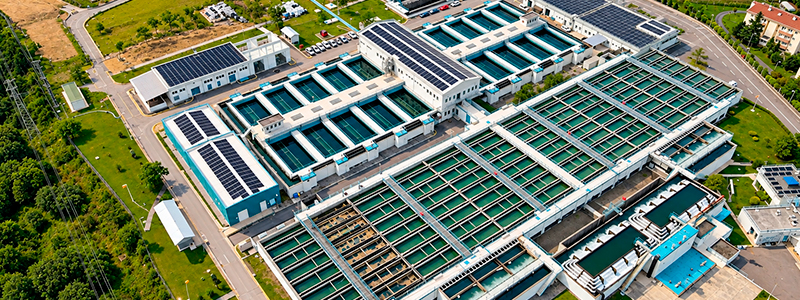
A Water Treatment Plant (WTP) operates as a continuous chemical treatment process. It must respond 24 hours a day to raw water whose turbidity, color, pH, and alkalinity vary with the seasons and with every rainfall event upstream of the water intake.
The stability of treated water depends on two conditions that must be ensured long before the water reaches the storage reservoir: raw water must reach the treatment plant without interruption, and each chemical reagent must be applied at the correct dosage, at the right point in the process, using equipment made from materials compatible with the chemical being handled.
1. Water Treatment Plant Process Flow (WTP)
Most water treatment plants in Brazil use conventional treatment, also known as the complete treatment process:
Water Intake → Coagulation and pH Adjustment → Flocculation → Sedimentation → Filtration → Disinfection and Fluoridation → Water Storage
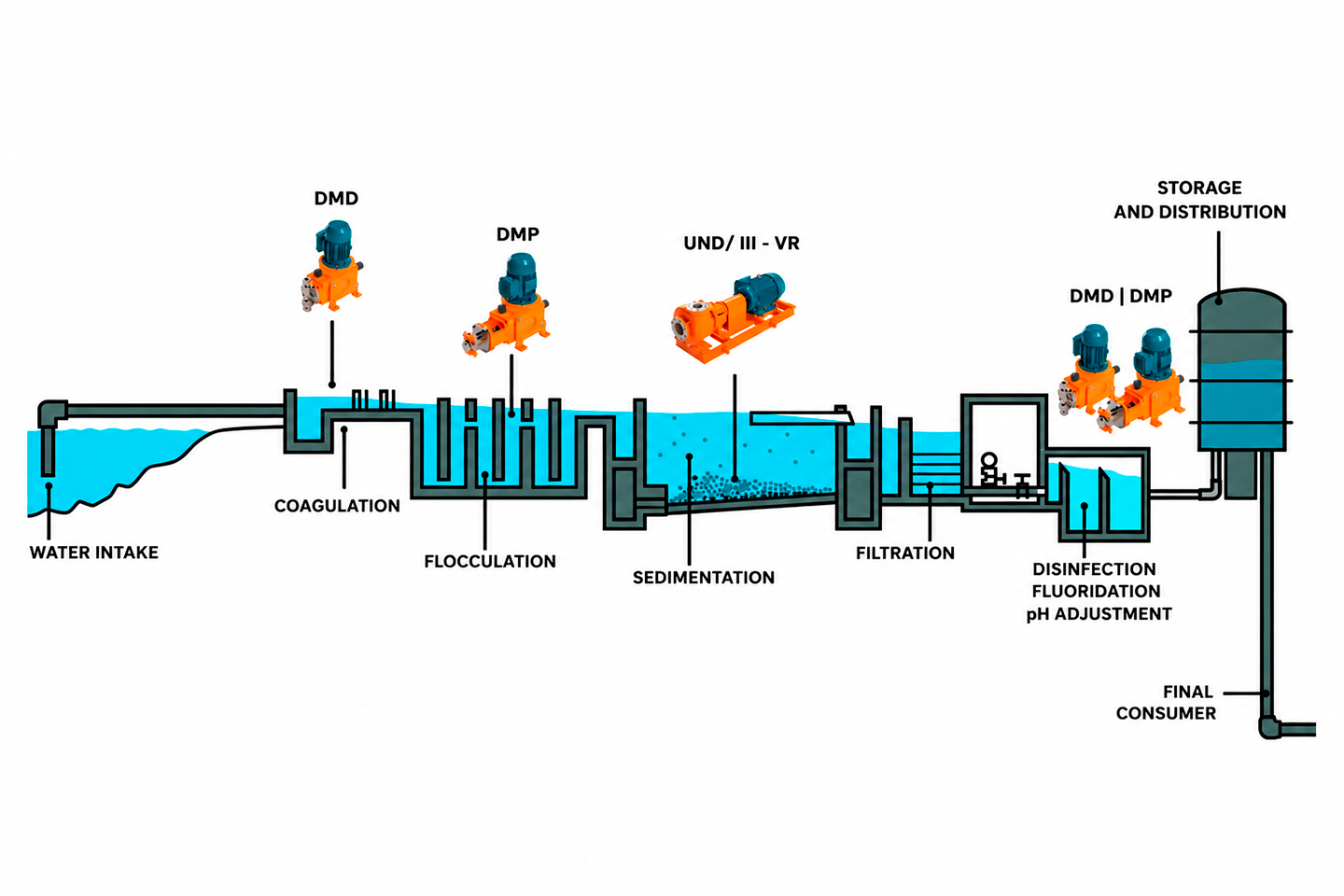
Each stage has different requirements. At the water intake stage, the primary requirement is hydraulic: pumps must start reliably, even when installed above the water level. During coagulation, disinfection, and fluoridation, precision is essential because chemical dosages are measured in milligrams per liter.
Throughout the treatment plant, there is also a network of chemical reagents and utility systems whose flow rates must be monitored by operators.
This article focuses on these three areas—water intake, chemical dosing, and flow measurement—where OMEL equipment directly contributes to the stability of the treatment process.
2. Raw Water Intake: Priming with BVM Vacuum Pumps
At many water intake facilities, centrifugal pumps are installed above the river or reservoir water level to protect against flooding or facilitate maintenance.
Under these negative suction lift conditions, a well-known problem arises: centrifugal pumps cannot pump air. If the suction line and pump casing are not completely filled with water at startup, the pump will rotate without delivering water. Even worse, the mechanical seal or gland packing may operate dry and suffer damage immediately upon startup.
The traditional solution, a foot valve, remains submerged and exposed to leaves, sand, and deposits, often failing without warning. For this reason, critical water intake facilities use vacuum priming: a vacuum pump removes air from the suction line and pump casing, allowing atmospheric pressure to push water into the line until the centrifugal pump is completely filled.
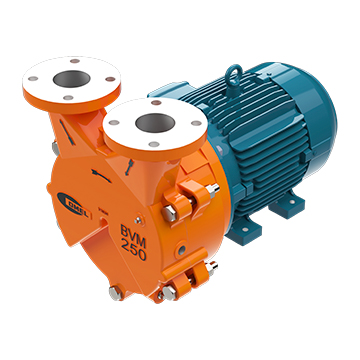
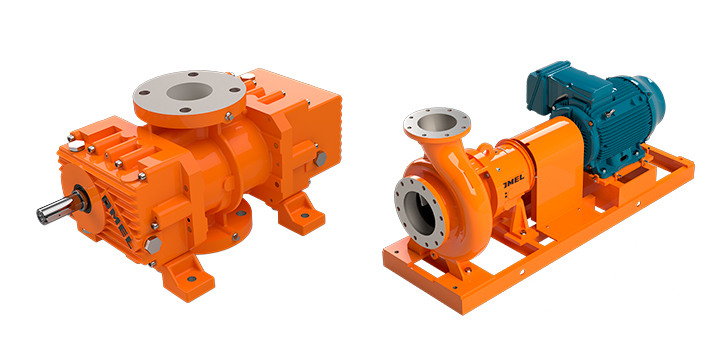
OMEL BVM Series liquid ring vacuum pumps are designed for this application. Water itself serves as the pump’s sealing liquid, meaning that any water carried into the vacuum pump at the end of the priming process can be handled safely due to its operating principle.
Key Advantages of the BVM Series
The following are the key features that make the BVM Series the ideal solution for priming pumps operating under suction lift conditions.
- Resistant to impurities and small foreign particles drawn into the pump.
- Accumulated vapors and liquids are drawn in and discharged.
- Completely oil-free compression, particularly important for applications involving water intended for human consumption.
- Low noise levels (lower than those of the electric motor itself), with construction options available in corrosion-resistant alloys.
The BVM Series offers an air suction capacity ranging from 30 to 750 m³/h and vacuum pressures down to 40 mbar (-730 mmHg) without ejectors.
Applications in Water Treatment Plants (WTPs): Priming water intake pumps operating under negative suction lift conditions and centralized vacuum systems that keep multiple pumps continuously primed through a common manifold and separator chamber.
One important sizing consideration is often overlooked: the vacuum pump is not selected based on the water intake flow rate, but rather on the volume of air to be removed (from the suction piping and pump casings), the suction lift, and the desired priming time.

3. Chemical Dosing: Coagulation, pH Adjustment, Polymers, Disinfection, and Fluoridation
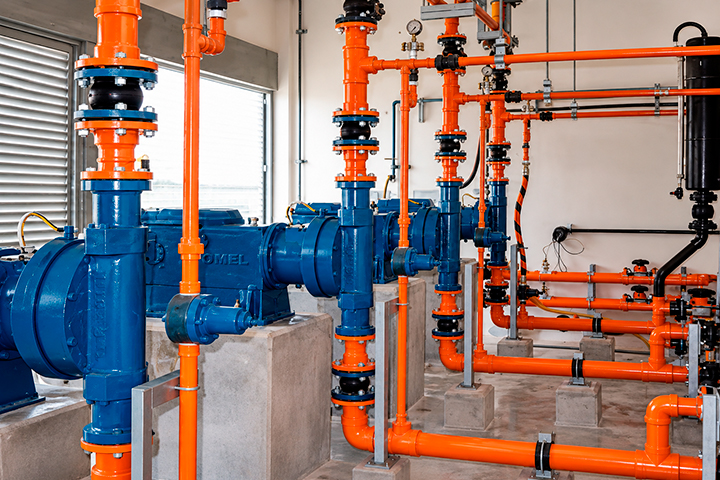
Coagulation determines the overall performance of the water treatment plant. The coagulant (aluminum sulfate, ferric chloride, or polyaluminum chloride) destabilizes the particles responsible for turbidity and color in the water, and this reaction is only effective within a specific pH range.
For this reason, coagulant dosing is accompanied by the addition of an alkalizing agent and, in many cases, a polymer used as a flocculation aid.
Underdosing produces weak flocs that fail to settle properly and overload the filters. On the other hand, overdosing increases chemical consumption costs and residual aluminum or iron levels in the treated water.
The results of chemical dosing become evident in the sedimentation tanks: flocs carried out of these units are rarely caused by problems with the sedimentation process itself and are almost always a sign that the coagulant dosage or coagulation pH is outside the optimal range.
After filtration, the operating limits become even more restrictive. The disinfectant must maintain an adequate residual concentration throughout the distribution network, while fluoride levels must remain within the recommended range without exceeding the maximum limit of 1.5 mg/L, established by the Brazilian drinking water quality standard under Ordinance GM/MS No. 888/2021.
At all these stages, dosing equipment must simultaneously meet three essential requirements:
- Repeatability.
- Wide and linear adjustment range to accommodate variations in water flow rate and chemical dosage.
- Chemical compatibility with the product being handled.
OMEL meets these requirements with four families of metering pumps.
Water Flow Rate × Dosage [mg/L] → Chemical Mass [kg/h] → Solution Flow Rate [L/h] → Metering Pump Adjustment
Diaphragm Metering Pumps – DMD
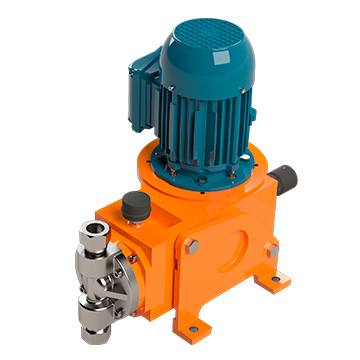
Featuring a mechanically actuated elastomeric diaphragm, a compact monoblock design, and a completely leak-tight pump head, the DMD Series provides a robust solution for the continuous dosing of coagulants, alkalizing agents, and diluted polymers, with the following features:
- Up to six pump heads driven by a single drive unit, each with independent adjustment: one assembly can dose coagulants, alkalizing agents, and polymers.
- Micrometric screw adjustment, which can be performed while the pump is stopped or operating.
- Variable frequency drive (VFD) operation for chemical dosing proportional to the raw water flow rate.
The DMD Series operates with flow rates of up to 1,140 L/h, pressures of up to 10 bar, and repeatability of ±3%. Pump heads are available in polypropylene or stainless steel, with Santoprene diaphragms.
NSP Diaphragm Metering Pumps
Hydraulically actuated diaphragm: a piston displaces a precise volume of oil, which moves the diaphragm in contact with the chemical reagent. This is the preferred choice when dosing requires greater precision or when the chemical demands enhanced safety, such as in disinfection and fluoridation applications.
- Linear adjustment from 0 to 100%, with a maximum error of 1%.
- Internal relief valve in the hydraulic system, eliminating the need for a safety valve in the discharge line.
- Triple diaphragm with rupture detection sensor for hazardous chemicals such as fluorosilicic acid.
- Tubular diaphragm for liquids containing fine suspended solids, such as lime slurries.
- Electrical or pneumatic control through process instrumentation, allowing the pump to function as a final control element.
The NSP Series handles flow rates ranging from a few liters per hour up to approximately 2,000 L/h, with pump heads available in stainless steel, Hastelloy, Alloy 20, Monel, PVC, PTFE, or polypropylene.
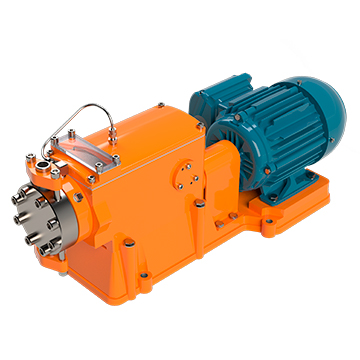
DMP and NSP/P Piston Metering Pumps
In large water treatment plants, coagulant flow rates can reach thousands of liters per hour, and chemical dosing becomes automated.
OMEL piston metering pumps meet these requirements with the following features:
- DMP: Modular design, with up to six pump heads driven by a single drive unit, oil-bath lubrication, and a maximum error of 3%.
- NSP/P: Linear adjustment with a maximum error of 1% and automatic adjustment through a pneumatic or electropneumatic actuator.
- Pump heads: Available in metallic alloys or entirely plastic materials (PVC, HDPE, polypropylene, and PTFE).
The DMP Series operates at flow rates of up to 1,040 L/h per pump head, while the NSP/P Series handles flow rates of up to 5,550 L/h.
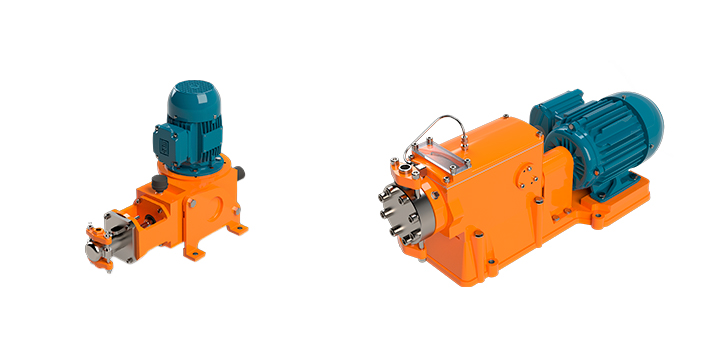

To select the appropriate pump model and construction materials, it is essential to consider the fluid being pumped, its concentration, and its temperature.
OMEL has a team of specialists available to provide technical assistance throughout every stage of the pump purchasing process.
4. Flow Measurement: OMEL Rotameters
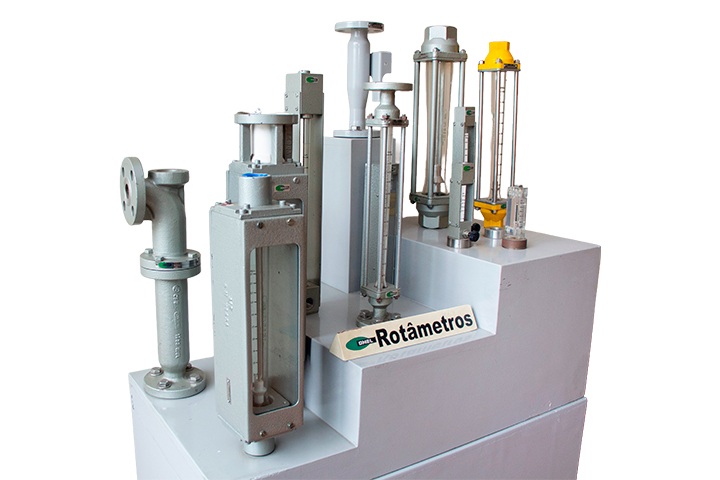
In addition to chemical dosing lines, a Water Treatment Plant (WTP) has a network of continuous flows that operators must monitor, including water for polymer dilution and preparation, pump sealing water, purge lines, washing operations, air, and utility gases.
OMEL rotameters, which are variable-area flowmeters, provide operators with direct and continuous flow rate readings without requiring electrical power.
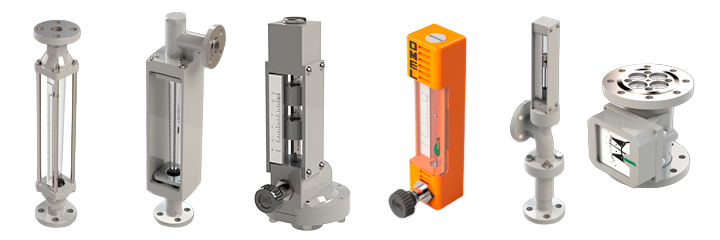
The main models are listed below:
- Models T and N (borosilicate glass tube): Direct reading with standard accuracy of ±2% of full scale, a special version with ±1% accuracy of the indicated reading (ISA RP 16.1.2.3), and repeatability of 0.5% of full scale.
- Model P: Small-diameter connections designed for low flow rates, such as purge lines and small piping systems.
- Model 1P5P: Made entirely from injection-molded plastic, lightweight and economical, suitable for operating temperatures up to 50°C.
- Metallic Models R4M and M250: Designed for opaque fluids or fluids that are corrosive to glass. The M250 also supports a 4–20 mA transmitter and alarm contacts, allowing flow rate data to be transmitted to the supervisory control system (SCADA).

Rotameters are also used in water meter testing benches operated by water utilities, where they serve a specific function. In these testing benches, water meter measurement error is determined volumetrically by comparing the meter reading with a calibrated volumetric tank or weighing scale.
The rotameter serves as a flow indicator, allowing the operator to adjust the flow rate at each test point (minimum, transitional, and permanent flow rates) within the range required by the applicable standard, using a measuring tube specifically sized for each test point.
Conclusion
A Water Treatment Plant (WTP) depends on proper control of every stage, with the most critical points being water intake and chemical dosing.
A water intake pump that fails to start interrupts the water supply, just as chemical dosing outside the required range compromises coagulation, disinfection, or fluoridation.
For this reason, equipment selection must be based on the specific requirements of each treatment stage:
- BVM Vacuum Pumps for priming water intake pumps.
- DMD, NSP, DMP, and NSP/P Metering Pumps, selected according to dosing range, accuracy, and chemical compatibility.
- OMEL Rotameters for direct visualization of instantaneous flow rates.
With this range of equipment, OMEL contributes to more stable, safe, and reliable operation of Water Treatment Plants.
In addition to these solutions, OMEL offers other equipment suitable for WTP applications, such as air scouring of filters, supported by the SRT Roots Blower, and chemical receiving and transfer operations, performed by OMEL UND/III Process Centrifugal Pumps.
These applications will be addressed in future articles.
Need Help?
Share your water treatment plant’s operating conditions: chemical reagent and concentration, dosing range, treated water flow rate, pressure at the injection point, and, for water intake applications, suction lift and piping volume.
OMEL’s technical team will recommend the appropriate configuration of metering pumps, vacuum pumps, and rotameters for your Water Treatment Plant (WTP).