

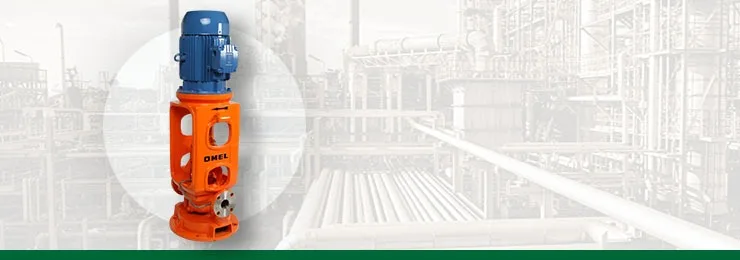
Vertical In-Line Centrifugal Pumps are process pumps designed for in-line installation in piping systems. They are widely used in the chemical and petrochemical industries for medium to heavy-duty applications such as:
- Chemical industry: transfer of various products, whether corrosive or not, loading and unloading of acids, transfer of organic products, pumping of products such as sulfur, urea, ammonia, liquefied gases, solvents, monomers, polymers, and other organic or inorganic products.
- Petrochemical industry: pumping of aromatics, light hydrocarbons, heat transfer fluids, tower reflux and bottoms, condensate transfer, etc.

Compact installation in reduced space
The design of the Vertical In-Line Centrifugal Pump provides a space-saving solution for installation, occupying a much smaller footprint than a standard horizontal centrifugal pump. For this reason, this type of pump is ideal for use in compact installations or in systems that require installation in limited spaces.
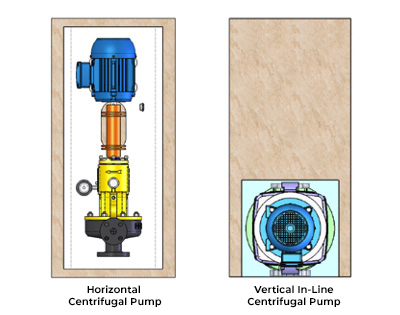
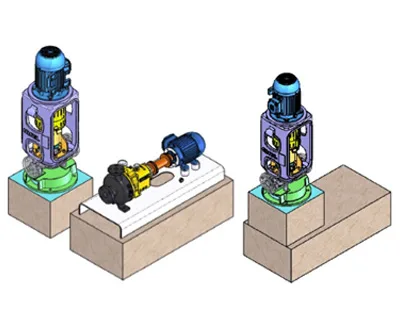
The pump is installed in-line and at the same level as the piping, as if it were a valve. In this way, there is no risk of misalignment.
There is no need for a special base or foundation for installation. Since it is not fixed to the floor, the pump can move with the piping, eliminating the need for expansion joints. In cases where mounting on a base is required, it is significantly smaller compared to the size of the pump.
These advantages make the pump installation process simpler and reduce costs with piping, bends, joints, etc., which can be clearly identified already in the installation design phase.
Ease of maintenance
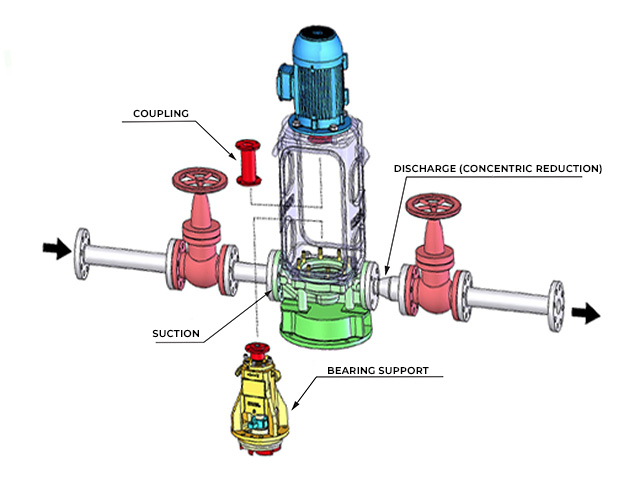
Maintenance of a Vertical In-Line Centrifugal Pump is much simpler than that of other types of pumps, as it is not necessary to disconnect the pump from the piping.
Designed in accordance with ANSI-ASME B 73.2 and/or API OH3 standards and using a back-pull-out system, by removing the coupling spacer and the bearing support assembly, the seal, shaft, and rotor can be easily extracted. There is no need to handle the motor, and the casing remains fixed to the piping.
Alignment
Another important aspect is that the need for alignment between pump and motor is eliminated, since this alignment is permanently performed at the factory. When removing the bearing support assembly, seal, and rotor, the motor remains fixed to its support on the pump casing, maintaining perfect alignment.

Check out our OMEL video on YouTube
Main design features of the Vertical In-Line Centrifugal Pump
• Compliant with major ANSI and API standards according to the desired application
• Bearings and sleeves made from specially selected alloys to ensure long service life
• Efficient and practical design that allows quick preventive and corrective maintenance
• Interchangeable parts among compatible models
• “Back pull-out” construction, enabling rear removal of the bearing support
• Dedicated bearing support without the need for motors with special shafts or tolerances
• Large sealing chamber allows installation of various types of mechanical seals, cartridge seals, packing, and sealing accessories
• Double-row ball bearings to prevent overloading of the motor bearings
• Parts in contact with the pumped fluid can be cast in a wide variety of alloys
• Low NPSHr and factory pre-aligned
The importance of correctly selecting the model and materials of a centrifugal pump
When sizing a centrifugal pump, it is important to consider the pump flow rate and the chemical compatibility between the pump’s construction materials and the operating fluid. The fluid may chemically attack the casing and internal components of the pump. The correct selection of the model, technical specifications, and construction materials of the centrifugal pump is essential to ensure the best performance and efficiency in the system, reduce costs with unplanned maintenance, and increase the equipment’s service life.